

Ever since the middle of the sixteenth century the House of Commons had assembled in St. Stephen’s Chapel. Located in the heart of the medieval Palace of Westminster, St. Stephen’s was acquired by the Crown in 1547/8 and converted for use by the lower House. Ninety feet long and around 30 feet wide, it was two storeys high with an octagonal tower at each corner. On the ground floor was an undercroft known as St. Mary-in-the-Vaults,
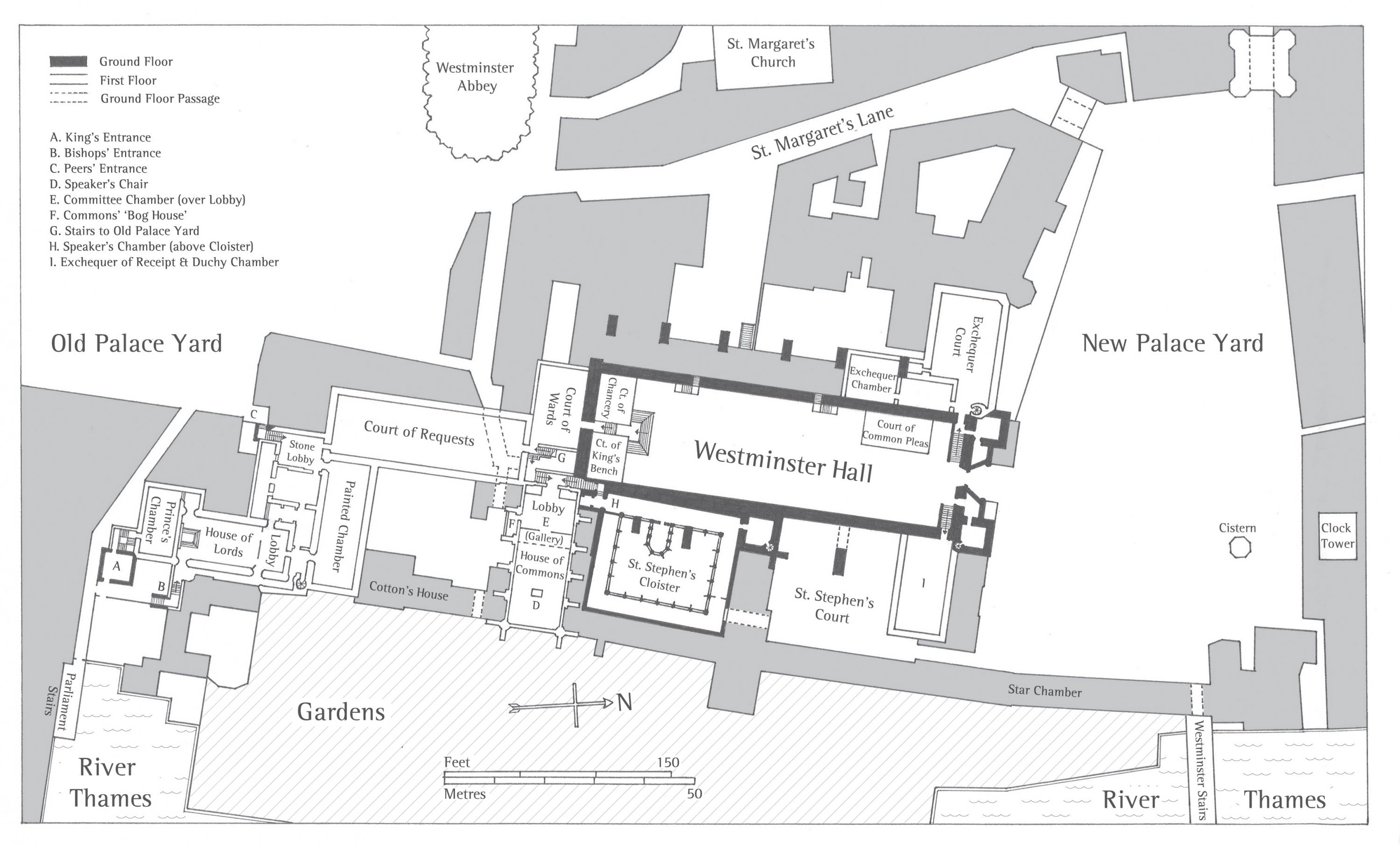
Conjectural plan of the Palace of Westminster in the early seventeenth century
There were several doorways leading into the palace, but perhaps the principal point of access for most Members was from New Palace Yard. Here they might leave their coaches,
The stairs and the lobby
The stone staircase leading to St. Stephen’s Chapel consisted of thirty-two steps and was situated in the south-east corner of Westminster Hall, next to the court of King’s Bench. At the top stood an arched doorway, through which lay a landing; to the left stood the entrance to the lobby of the House of Commons, while ahead lay a further set of stairs which led down to the Court of Wards and the Court of Requests.
During James’s reign the stairs continued to act as a focus of disorder. In January 1606 several pages on the stairs ‘much abused the passengers’ and set upon two of the clerks in King’s Bench, for which they were imprisoned by the judges.
The lobby played an important part in the life of the Commons. Described by the office of Works as ‘a big room’, one of its main functions was to serve as a waiting area for suitors, and those witnesses and counsel who were required to appear at the bar of the Commons.
As well as a waiting area, the lobby, which was re-floored ahead of the 1604 session, served as a workroom for the clerk’s assistants, who sat at a ‘long table’.
A third important function of the lobby was to enable the House to hold divisions. When a vote was held the outer doors, which opened onto the landing, were shut, and anyone in the lobby at the time was sent upstairs to the committee chamber. Once cleared, one side trooped into the lobby to be counted, while the other remained in their seats.
The lobby was occasionally pressed into service at the beginning of a Parliament. In 1593 the newly elected Members took the Oath of Supremacy at ‘the Parliament door’. Four years later the Court of Requests was employed for this purpose instead, but the process took too long as the lord high steward and his deputies, seated at a little round table, were able to swear in only a few Members at a time. In frustration two of the deputies, Secretary Cecil and Comptroller Knollys, retired to the lobby, where they seated themselves at the end of the long table and began swearing in Members in groups of seven and eight.
On rare occasions the lobby was used for impromptu meetings. In May 1606, for instance, the committee for the distribution of the money collected from Members ‘met at the Parliament door’ and considered its business ‘in the utter chamber’.
Just off the lobby, probably in one of the two bays formed by the buttresses on the south wall, was a small room. Writing in the 1640s, Sir Edward Peyton recalled that, while serving as Member for Cambridgeshire in 1621, he had been called out of the chamber by the serjeant ‘to the little room in the lobby’, where three of his colleagues offered him £10,000 if he would refrain from opposing the fen drainage bill.
The Commons chamber
Around forty-two feet from floor to ceiling,
The floor of the chamber, like that of the lobby outside, was constructed of wood. By the beginning of James’s reign many of the boards were so damaged that they had to be repaired before Parliament met in 1604.
Many contemporary illustrations of the Commons’ interior show that at the eastern end of the chamber the seats were arranged in a curve around the Speaker’s chair. This not only made it possible to see the Speaker more clearly, but also allowed a further short rank of seating, capable of taking up to five Members, to be inserted in each corner.
The gallery soon displaced the ‘rebellious corner in the right hand of the House’ as ‘the resort of mutineers’.
Near the eastern end of the chamber, in the middle of the front row of benches placed along that wall, sat the Speaker in a special chair that was raised on a small, stepped platform.
Green cushions may have been provided for the comfort of the Speaker and the privy councillors in the House. Certainly thirteen such items were in the serjeant-at-arms’ possession in 1576.
Behind the Speaker, overlooking the Thames, was the great window, which occupied almost the entire eastern end of the chamber. Its lower lights, consisting of twelve or sixteen individual windows, could be opened outwards and perhaps provided the main source of ventilation.
Below the Speaker was a table at which sat the clerk of the Commons and one of his servants. Often referred to as ‘the board’,
Directly opposite the table, in front of the door, lay the bar, which was fixed in a post. Normally it was kept raised, presumably to allow Members to come and go freely, but except when the earl of Southampton and Lord Sheffield were allowed to hear the debate relating to the Virginia Company in May 1614 it was lowered when outsiders were brought in.
Members of the Commons, unless they were the Speaker or the chairman of a grand committee, seem rarely to have ventured beyond the bar onto the floor of the House, unless it was to reach their seats. However, it may not have been unusual for reporters from committee to do so: in April 1604 Sir Francis Bacon related the deliberations of the committee on the Union while standing next to the clerk’s chair.
In 1593 the chamber acquired a clock, paid for by the Members themselves.
There were evidently fireplaces dotted around the chamber,
The committee chamber
Immediately above the lobby, on a mezzanine level, was the committee chamber. Like the main chamber the committee room was matted, but here there was a table around which Members could sit. In 1604 the committee chamber was described by the Works’ department as ‘a little room’.
As its name suggests, the committee chamber provided a venue for committees. However, being small it was generally considered suitable only for those committees consisting of less than 20 Members. (That said, in May 1604, a 33-strong committee was appointed to meet there to consider the bill to restore in blood Lord William Howard).
Owing to its proximity, the committee chamber was ideal for performing business that needed to be transacted immediately. Whenever the House decided that a message or bill was not quite worded correctly, or one or two details needed modification, the original committee, with some Members added for the purpose, was immediately sent upstairs to redraft the offending passage or clause. A clear instance concerns the Commons’ response to Bishop Neile’s outburst against the lower House in May 1614. On 26 May the Commons appointed a committee to meet that afternoon in the Court of Wards to draft a protest to the Lords. However, when the committee’s draft was read out the following morning, Sir George More objected that ‘the latter part … differeth from the Order’, whereupon the drafting committee was ordered to reassemble ‘presently’ in the committee chamber, along with several additional Members. A short while later the ‘recommittees’ returned, having redrafted the offending passage, and the whole message was approved.
The smallness of the committee chamber was not the only reason it was used infrequently as a committee room. It was often needed for other purposes, and these tended to preclude its use by committees when the House was sitting. One of these additional functions was as a holding room during divisions. That is to say, any Member in the lobby when a division was called was sent upstairs to the committee room until the voting had ended. Another purpose to which the committee chamber was occasionally put was to act as a waiting room. Under normal circumstances witnesses seem to have been expected to use the lobby, but where it was feared that they might influence one another if they met, one or other witness was invariably sent upstairs. During the impeachment of Lord Treasurer Middlesex in April 1624, for instance, Abraham Jacob ‘was sent into the committee chamber, that he might not confer with other witnesses’.
One of the key functions of the committee chamber was to serve as a withdrawing room for the Speaker. In 1604 it was prepared for Speaker Phelips before the newly elected Members of the Commons were summoned to the Lords to hear the king’s speech. On this particular occasion Phelips declined to use the room, but in May 1606 he ‘stayed in the committee chamber to remember his speech to the king’.
Like the Speaker, ordinary Members may have made use of the committee chamber informally when it was not otherwise needed. In March 1626 Sir Thomas Bludder penned a letter to the earl of Middlesex on recent events in the Commons, a missive which seems to have been written from the committee chamber, as Bludder mentions that it was in this room that he found the paper on which to write.
Other committee venues
As the Commons possessed only one small committee room, most of its committees had to meet elsewhere. Under Elizabeth it was not uncommon for bill committees to meet in the main chamber itself.
Many committees during Elizabeth’s reign had met outside Westminster, some in the Guildhall, others at Serjeants’ Inn or the Inns of Court, which were situated in and around Chancery Lane. By far the most popular venue among the four Inns was the Middle Temple, which hosted meetings in its ‘Parliament chamber’. Although used sparingly in 1593, the Middle Temple was invariably the second-most popular meeting place, and in 1571 no less than 38% of all committees were ordered to meet there. The remaining Inns were less frequently in demand: Gray’s Inn was not employed before 1597, while the Inner Temple was not brought into use until 1601, at which time Serjeants’ Inn ceased to serve as a committee venue. Lincoln’s Inn, however, was the designated meeting place of four per cent of committees in 1586.
Between 1604 and 1607 the Commons continued to use the Inns of Court regularly. In 1604, for instance, the Inner Temple served as the meeting place for both the committee for privileges and eight bill committees.
The emergence of the committee of the whole House signalled the decline rather than the end of the use of the Inns of Court as committee venues. When the Commons instructed its Members from Lincoln’s Inn to draft an elections bill in March 1621, it naturally ordered them to meet in their inn.
Even before the committee of the whole House made it undesirable for smaller committees to continue meeting in the Inns of Court, the majority of committees assembled in the law courts situated in the Palace of Westminster. As the courts sat only during the morning, their rooms were available in the afternoon during term time, and during vacations they were free all day. Use of the law courts enabled Members to move swiftly from committee to the Commons’ chamber, and vice versa. After attending a bill committee in one of the rooms off Westminster Hall in April 1606 Robert Bowyer recorded that he and Lord Buckhurst ‘went both into the House’.
From the mid-1570s the most popular committee venue by far was the Exchequer Chamber. Rebuilt in the mid 1560s, and with a brick and stone exterior, the Exchequer Chamber served as the upper court of the Exchequer, and was situated on the western side of Westminster Hall between two buttresses.
Next door to the Exchequer Chamber, off the north-western corner of Westminster Hall in an upstairs room, was the Exchequer Court, which served as the lower court of the Exchequer. Compared with the Exchequer Chamber, the Exchequer Court was barely used as a committee room, although it was apparently ‘a fair large place’.
Next to the Exchequer of Receipt lay the law court of the duchy of Lancaster.
A short distance to the north and east of the Duchy Chamber, housed in a range of buildings on the eastern side of New Palace Yard, lay Star Chamber.
If Star Chamber was the courtroom furthest from the Commons, the closest were those of King’s Bench, Chancery, Wards and Requests. The first two, however, were unsuitable as committee rooms, as they, like the slightly more distant Court of Common Pleas, were situated in Westminster Hall behind partitions that can have afforded little or no privacy. The Court of Requests, by contrast, was housed in the White Hall, a large, two-storey medieval building, second only in size to Westminster Hall.
The Court of Wards and Liveries was a self-contained brick building which, like the Exchequer Chamber, dated from the mid 1560s. Located off the southern end of Westminster Hall, and easily reached, either through Westminster Hall or from stairs leading from the landing outside the Commons’ lobby, it (like Star Chamber) consisted of two separate chambers, the ‘inner’ and ‘outer’.
The increased use of the Court of Wards may have been made possible by the master of the Wards who, with the exception of the parliaments of 1624 and 1628-9, was a Member of the Commons himself from 1614. In 1628-9, when use of the court reached its peak, the Commons probably relied on the goodwill of two other of its Members, the usher of the Court of Wards, Sir Thomas Farnefold, and his colleague, the attorney of the Wards, Sir Walter Pye. The reason that the Court of Wards emerged as the Commons’ principal committee room is probably that the lower House could no longer afford to disregard such a useful space on its own doorstep. As has been seen, the emergence of the committee of the whole House forced the Commons to reduce its dependence on rooms outside the Palace of Westminster – hence the spectacular decline of the Middle Temple as a venue. Since the Exchequer Chamber was already heavily used, the Commons was obliged to seek out other suitable court rooms that had previously been neglected, such as Star Chamber, which to some extent recovered the important position it had held under Elizabeth as a committee venue. However, the main source of additional space was provided by the Court of Wards, as the Court of Requests was, for reasons that remain unclear, evidently considered unsuitable. The transformation of the Court of Wards into the Commons’ main committee rooms was one of the most striking developments of this period, and was almost certainly a consequence of the rise of the grand committee.
The Commons’ records repository
During the final stage of converting St. Stephen’s Chapel for use by the Commons in 1552-3, provision was made for ‘safe keeping the records’ at a cost (with other minor works) of nearly £40. It is not clear where space was found, but Alasdair Hawkyard’s suggestion that it may have been in the attic of the Commons’ chamber is probably correct.
For the clerk and his assistants, the storage of the records in the attic evidently proved unsatisfactory. Equally inconvenient was the continued use of the lobby as a workroom. Consequently, in May 1604 a motion was made in the House ‘that there might be a special place built, and assigned, for the keeping of the register and records and papers of the House’, and for use as a workroom.
There can be little doubt that, despite the building work in the Court of Requests, the Commons’ records continued to be lodged in the roof space over the Commons. Indeed, in 1649/50 a committee of the House of Commons was so concerned at the weight of the records in the roof that it commandeered space in the ‘treasury’ of the former Court of Wards.
The driving force behind these complaints may not have been the absence of a repository but the inadequacy of the attic and the habit of successive clerks of treating the Commons’ records as though they were their own private property. Following the death of the clerk, Ralph Ewens, in 1611, many of the Commons’ records went missing because Ewens had kept them at home. On learning of this, an alarmed Sir Edwin Sandys proposed in April 1614 that the committee for privileges be instructed to ‘consider of a safe course for keeping the Journals and other the memorials and records of this House’. It was essential, he added, that the committee should ‘consider of a fitting place to keep them in’, so that they did not fall into the hands of executors.